Radar Tag: ai
All radar links tagged "ai".
-
Mathematics in the Age of AI Slide PDFs by Terence Tao teorth.github.io
What a privilege to live in a time with Terence Tao. His clarity of thought is my favorite attribute of my favorite mathematicians.
These quotes seemed particularly relevant, even to software:
These statements particularly rung true:
However, the writing often dwells at length on trivialities, while passing very briefly through (or even obscuring) the most interesting and novel portions of the argument.
A proof may end up being too slickly written — with both the routine and difficult parts of the argument being presented as equally easy to digest.
In a human-written proof, the parts of the argument that the author found difficult will typically retain some natural friction that prompts the reader to slow down and pay more attention.
An excessively AI-polished proof may remove both “artificial” and “natural” friction, without actually encouraging the reader to learn and understand the key ideas of the argument.
-
</> htmx ~ Code is Cheap(er) In this essay, Carson Gross argues that as AI makes code cheap to produce, understanding code becomes the expensive and scarce resource. He warns of the complexity that LLM code can generate and proposes the subtractive, constraining engineer as the discipline needed to keep systems comprehensible & stable. htmx.org
This essay matches some of my thinking around AI-assisted engineering. I especially like the defense of coding as a skill, even in the face of its automation.
The idea that understanding is now more valuable than before is true. Coding was how we got there. Can we get there without the necessary steps leading up to it? It makes me think of stage vs film actors: the former have the entire play to build up emotionally to the climax, but the latter have to sit and wait until the camera, set, lighting, makeup, costumes, and much else is ready, deliver full on without buildup, and get it right before everything is torn down.
If the doing is the understanding, how much can we understand without the doing?
-
Generative UI Is the New Frontend The frontend used to be a fixed thing. Designers drew it. Engineers built it. Users got what shipped. That's over. x.com
As much as I enjoy designing interfaces and working with people to craft something beautiful and usable, I do agree there is a big opportunity for generated interfaces. So much of what we do is not that unique: dashboards, charts, maps. And these widgets are now well defined enough that, given some data in parseable formats, AI should be able to generate UIs on the fly to help me slice it.
-
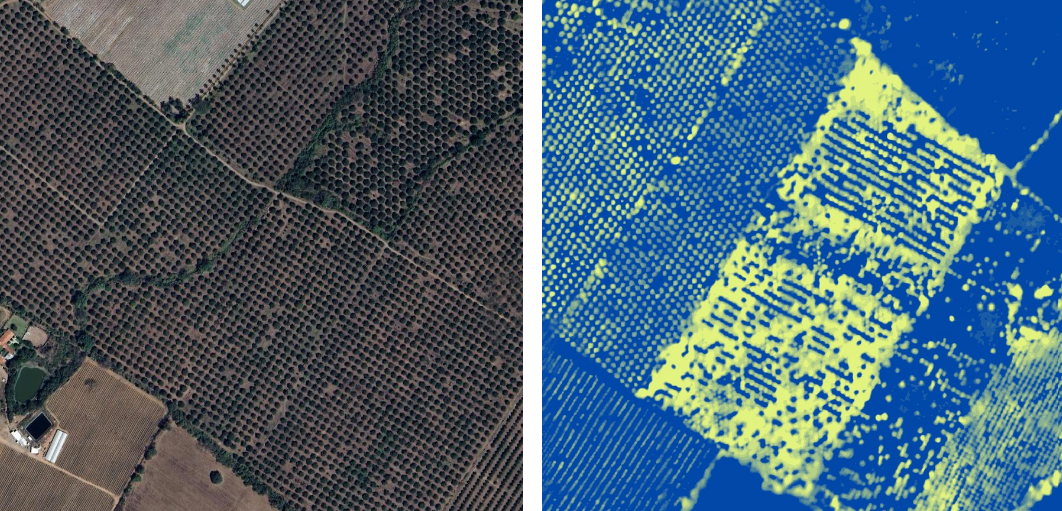 Mapping the World’s Trees in Unprecedented Detail with AI A new AI foundation model provides the world’s first global 1-meter map of tree canopy height, allowing the detection of single trees at a global scale. landcarbonlab.org
While groundtruthing is always ideal for all geospatial datasets, we're going to see more and more synthetic / AI assisted datasets like this one pop-up. Land Carbon Lab and WRI say they fine tuned DINOv3 by Meta to update this dataset from ~30m to ~1m, which is a huge upgrade. This will likely allow building more granular applications for decision makers. But will the caveats be surfaced? And will they be accounted for in the decisions made? Much opportunity here to build something really useful for communities around the world.
